
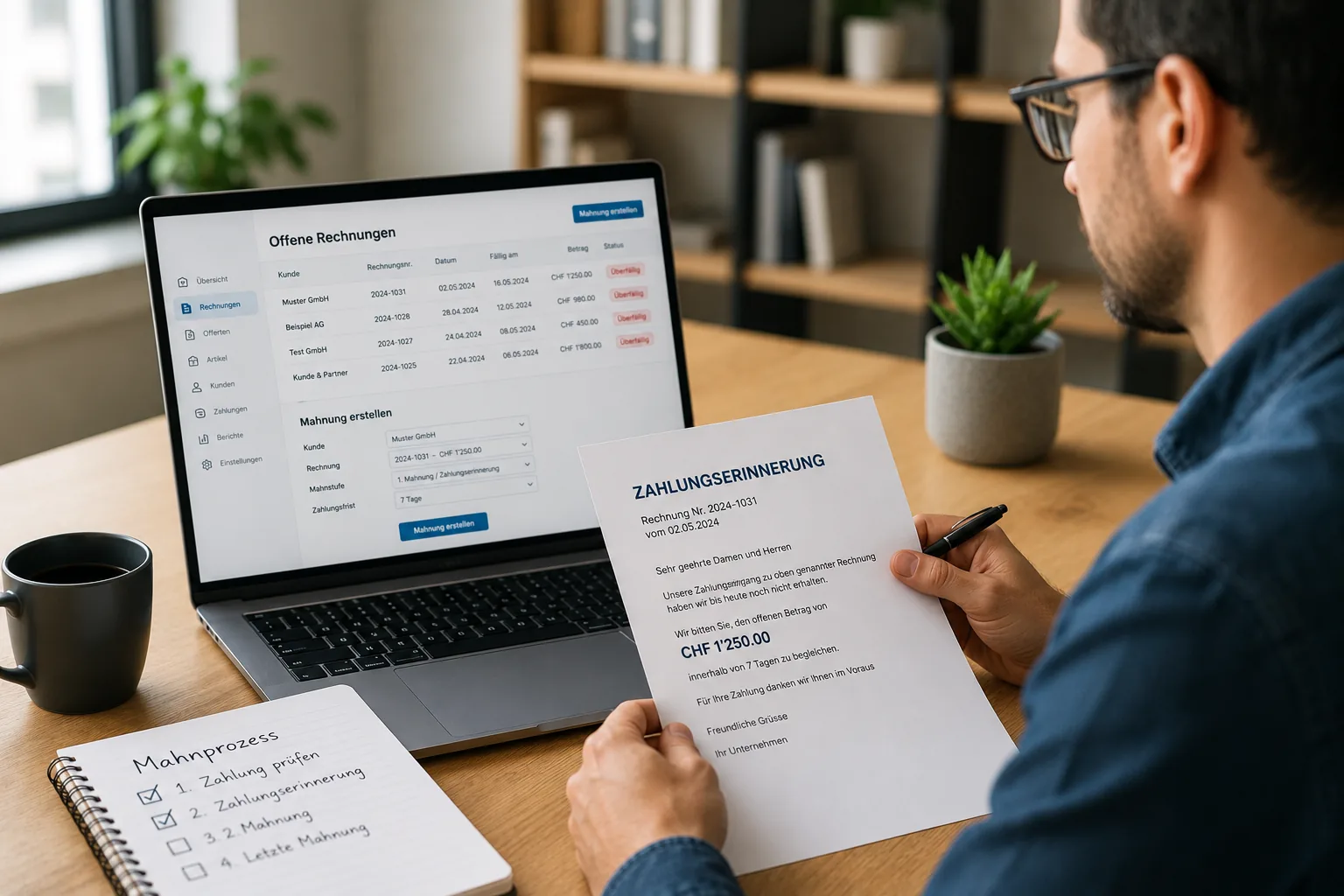
What is a payment reminder?
A payment reminder is a friendly reminder about an unpaid invoice after the due date has passed.
In practice it is often the first step, because late payment is not always intentional. Sometimes the invoice was overlooked or is still in an internal approval process.
That is why a short, calm reminder is often enough.
- stay friendly
- do not annoy customers unnecessarily
- name the open invoice clearly
- a short reminder is often enough
What is a formal reminder?
A reminder asks a customer to pay an unpaid invoice.
It refers to the original invoice, states the amount outstanding and usually sets a new payment deadline.
A good reminder stays factual, clear and traceable.
- reference to the invoice
- new payment deadline
- factual tone
- clear traceability
Payment reminder or formal reminder - what is the difference?
In daily business the terms are often used loosely. In practice, however, it helps to separate a friendly first step from a clearer follow-up.
| Criterion | Payment reminder | Formal reminder |
|---|---|---|
| Tone | friendly, restrained | factual, clearer |
| Timing | shortly after the due date | after no reaction or no payment |
| Goal | remind about payment | request payment more clearly |
| Binding effect | softer first step | clearer next step |
| Typical wording | Perhaps the invoice got lost | Please settle the outstanding amount by ... |
When should you send a reminder?
A reminder is useful when the due date has passed and no payment has been received.
Before sending anything, first confirm that the payment is really missing. Many unnecessary reminders happen because incoming payments were not reconciled yet.
A sensible order is: check the bank reconciliation, possibly ask briefly, then send a written reminder.
- check whether payment is actually missing
- review bank reconciliation
- briefly ask if needed
- then remind in writing
What does a sensible reminder process look like?
A sensible reminder process is gradual, calm and traceable.
1. Check incoming payment
First confirm that the invoice is still open.
2. Send a friendly payment reminder
Keep it short, polite and without unnecessary pressure.
3. Send a second reminder with a clear deadline
If nothing happens, the next due date should be stated clearly.
4. Send a final reminder with clearer wording
Still factual, but more explicit than before.
5. Review the next steps
In complex or disputed situations, further action should be considered carefully and with professional advice where needed.
What should be included in a reminder?
A reminder should summarise the open points clearly and in a traceable way.
- customer details
- invoice number
- invoice date
- outstanding amount
- original due date
- new due date
- payment information
- friendly, clear wording
Typical mistakes when sending reminders
The most common problems are caused less by a lack of pressure than by weak structure.
Waiting too long
If open invoices sit too long, follow-up becomes unnecessarily difficult.
Not checking incoming payment
A reminder for an invoice that was already paid looks unprofessional.
Using unfriendly wording
Harsh language usually harms the customer relationship more than it helps.
Not setting a new deadline
Without a new due date, the reminder stays vague.
Forgetting the invoice number
If the invoice is not identifiable, you create questions instead of clarity.
Not tracking open invoices
If reminders are sent only occasionally, overview is lost quickly.
Losing reminders manually
Scattered emails and files make the process harder to track.
How do you stay friendly and still clear?
A good reminder is factual, short and respectful - but still clear.
Friendly
Perhaps our invoice was overlooked in the daily routine. We kindly ask you to review the outstanding amount.
Firm
Please settle the outstanding amount by 18 June 2026.
Final reminder
Please transfer the outstanding amount by 25 June 2026. Otherwise we will review the next steps.
How fibu3 helps with reminders
fibu3 helps keep unpaid invoices visible and create reminders in a structured way.
The practical value is that invoices, incoming payments and reminders stay connected instead of being spread across separate tools.
That reduces manual follow-up.
- identify open invoices
- create reminders from existing invoices
- keep an overview
- see invoices, payments and reminders in one place
- less manual chasing
Short version: writing reminders in one sentence
Writing a reminder in Switzerland means requesting payment for an overdue invoice in a factual, traceable way with a clear new deadline, without unnecessarily harsh wording.
Checklist - before sending a reminder
Use these questions as a quick quality check.
- Has the due date passed?
- Was incoming payment checked?
- Is the invoice number correct?
- Is the outstanding amount clear?
- Is a new deadline stated?
- Is the tone factual?
Conclusion: writing reminders in Switzerland
When it comes to writing reminders in Switzerland, the goal is rarely to sound as tough as possible. What matters is a clear, calm and traceable process.
Businesses that first check incoming payments, start with a friendly reminder and then escalate step by step usually act more professionally than those using harsh standard texts.
Related topics
Useful internal links: writing invoices in Switzerland, recurring invoices, bank reconciliation explained simply, quote vs invoice, doing your own bookkeeping, pricing, learn and blog.
Frequently asked questions about reminders and payment follow-up
Short answers to common questions about reminder processes, delivery method, tone and unpaid invoices.
When should I send a reminder?
When the due date has passed and no payment has been received.
Is a payment reminder already a reminder?
In practice, often yes. It is commonly used as the first, friendly follow-up step.
How many reminders are common?
A gradual process with a friendly reminder, second reminder and final reminder is often sensible.
Do I need to send a reminder by post?
Not necessarily. What matters most is that the reminder is traceable and documented.
Can I send reminders by email?
Yes, that is common in practice as long as the delivery remains traceable.
What belongs in a reminder?
Customer details, invoice number, invoice date, outstanding amount, old and new due date and payment information.
How friendly should a reminder be?
Friendly enough to remain professional, but clear enough that the request is unambiguous.
Can I charge reminder fees?
That depends on the case and the underlying agreements. If in doubt, get professional advice.
What if the customer does not react?
Then the next steps should be reviewed consciously, especially in disputed or more complex situations.
How does software help with reminders?
Software helps track unpaid invoices, incoming payments and reminders in a structured way.
Can fibu3 create reminders?
Yes. fibu3 helps create reminders from existing invoices and keep unpaid invoices visible.
How do I avoid unpaid invoices?
With clear invoices, consistent follow-up, bank reconciliation and a clean reminder process.
Related fibu3 solutions
Keep unpaid invoices and reminders clearly under control
With fibu3, unpaid invoices, incoming payments and reminders stay visible together so follow-up becomes more structured.